Types of intergroup interaction
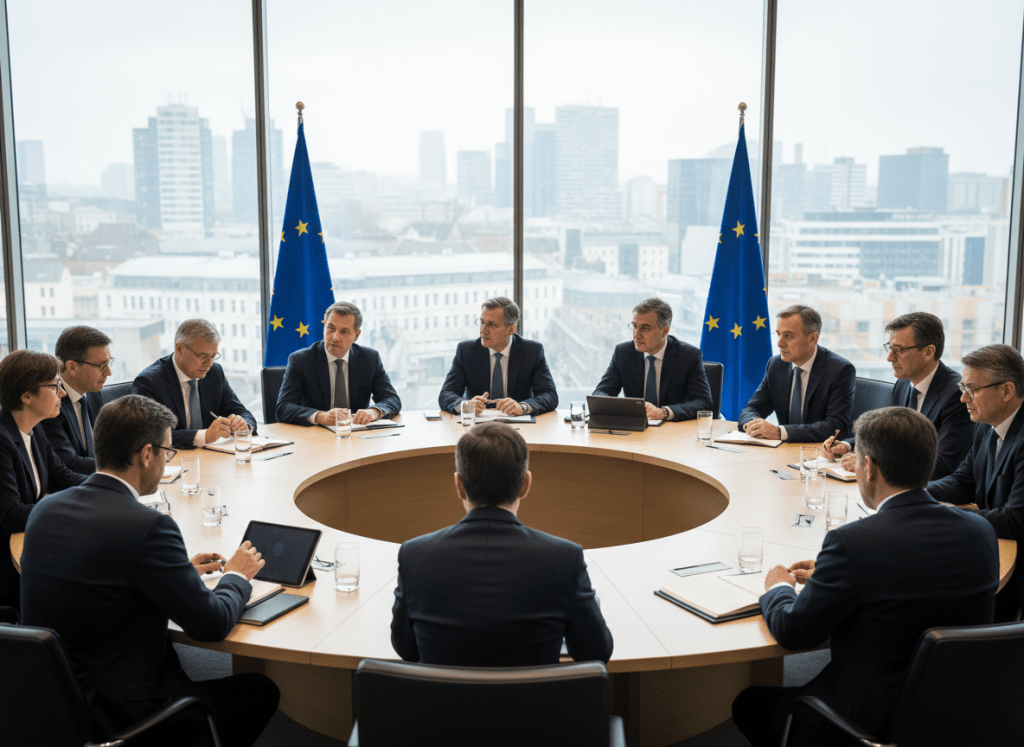
To exemplify some aspects of intergroup interaction, we now look at EUCO not as a group but as an organisation or institution formed of several smaller groups. This will allow us to analyse intergroup behaviour and interactions. The groups within the negotiations in EUCO are formed considering political affiliation and thematic affiliation. Belonging to a political family is essential in configuring a group in EUCO. They represent the main groups of parties such as the EPP, the S&D, Renew, etc. Leaders of the same political family meet before EUCO reunions to discuss general preparations for EUCO. For example, EPP leaders met in Brussels on 21 March 2024 before the EUCO reunion. EPP heads of state and government joined the President of the European Commission (also EPP) and the President of the European Parliament (EPP) in a morning meeting before the afternoon EUCO. EPP President Manfred Weber hosted the conference.
At the same time, negotiations in EUCO particularly emphasise the thematic criterion for configuring groups within the institution. The thematic criterion groups the heads of state and government according to their position vis-à-vis a specific topic. For example, when climate targets negotiations were held, a group of Central European members argued for a more flexible transitional approach, considering the different starting points and ensuring subsidies to support the economic impact. On the other hand, other member states that had started the green transition earlier advocated for a quicker pace and greater ambition from the EU. Generally, one tends to see different groups forming depending on the topics discussed: it is impossible that two heads of state or government share the same position across all topics. Configurations change. A corollary to this is the geographical criterion, which refers to groups that form depending on the geographical location of the member state. However, this criterion is trumped by the thematic criterion, mainly because the positions that member states have on various topics also reflect, in broad lines, their geographical location in the EU.
On an interdependence vs degree of compatibility matrix, the conceptual map proposes accommodation, avoidance, competition, and collaboration map, with compromise in the middle of the matrix; the intergroup behaviour ranges between collaboration and compromise, with occasional instances of competition. The level of interdependence in EUCO is high: the members sit together in reunions where they must reach decisions that will guide the EU over the next period. Furthermore, they need to make these decisions by consensus. The overarching goal of the various groups in EUCO is to achieve this shared understanding in the interest of the EU. This is why collaboration, through constructive negotiations, is the general approach, where even if positions may seem different, the overarching objective pulls them together.
In most situations, however, there is moderate compatibility between the groups in EUCO, which usually leads to situations that can generally be mapped in the compromise area on the matrix. There are also situations of higher levels of competition, particularly when resources are discussed, such as the Multiannual Financial Framework negotiations. This does not necessarily mean that the competition is taken out of the collaboration-compromise context but that this situation of a zero-sum game will increase competition. Situations with higher competition between the groups in EUCO also occur on topics for which there is a potentially more considerable political gain.
Regarding the causes of intergroup conflict, we will refer to two of them, namely, goal incompatibility and time incompatibility. This has been covered previously on several occasions in terms of goal incompatibility. During negotiations in EUCO, various groups of heads of state or government find themselves in opposing positions. Suppose one refers to climate negotiations (groups of member states favour a faster approach to reaching the climate goals, while others prefer a slower transition). In that case, MFF negotiations (cohesion vs. frugal approach), Ukraine or negotiations regarding nominations for the leadership positions in the EU (all-out negotiations) always find various groups arguing for different, often opposing positions. There is a goal incompatibility. However, it is also more of a perceived incompatibility since the heads of state and government can find venues towards compromise and identifying a common position.
Time compatibility, in the case of negotiations within EUCO, is often related to time constraints. EUCO occurs most often between Thursday at 3 pm and Friday at noon/afternoon. During this period of 24 hours, the heads of state and government need, in principle, to agree on the topics on the agenda. Time pressure often carries negotiations forward, as the leaders are more likely to agree to a compromise solution in the late night of the talks, during the early hours before adjourning or before calling an end to EUCO, knowing that they will either go home or go to another official state visit. As such, time incompatibility creates the premises for conflict between the groups in EUCO; however, at the same time, it also makes a potential impulse to finalise negotiations through time pressure.
There is a general acceptance that group members tend to become more cohesive when the groups conflict. This is valid for negotiations in EUCO but needs to be appropriately nuanced, and it usually depends on the talks at hand, the degree of salience and the importance attributed to that particular topic. If the topic is deemed of strategic and long-term significance, such as those regarding the EU’s multiannual budget, you would tend to see the groups becoming more cohesive. This means the groups will coagulate around their common position and promote this in the negotiations. On other occasions, such as in discussions regarding leadership nominations, one may also see cohesion built around the political family lines as a fallback.
Case study 1: A case of norm violation – Viktor Orban’s blocking of consensus.
EUCO of 14-15 December 2023 decided to open accession negotiations with Ukraine and the Republic of Moldova. However, this was done against the will of Hungarian Prime Minister Viktor Orban, who, despite the unanimity, refused to agree to the opening of accession negotiations with Ukraine. The problematic situation was solved in a manner not previously used during EUCO, where, by norm, the decision is taken by consensus and unanimity, and, by law, this is mainly the case when it comes to foreign policy, security, enlargement, and finances.
The Hungarian Prime Minister was asked to leave the room (reportedly by the German chancellor, something that will be further discussed below when referring to influence), allowing the 26 remaining leaders to make a unanimous decision. Abstention, as could thus be considered the case of Viktor Orban leaving the room, allows for the decision to be taken. The solution worked at that point, although this must be balanced, particularly since, as discussed, consensus is generally the rule in EU decision-making processes, particularly in EUCO.
Forsyth (2009) also mentions the concept of conformity in the context of majority influence. This means that people would agree if others in the group followed the same idea to avoid standing out. Again, this seldom happens in EUCO for the reasons previously presented. The political background of the leaders and their role as elected representatives of member states limit this possibility. The example with Prime Minister Orban is eloquent in that sense. There was no intention of conformity on his side when the decision to open accession negotiations with Ukraine was discussed. He preferred to leave the room, allow the decision to be made and return for the rest of the points on the agenda of discussions. In Nail, MacDonald, & Levy’s model (2000), the Hungarian Prime Minister can be labelled as an independent: he disagreed with the group before the discussion (as he expressed on many occasions) and disagreed publicly and privately with the group after each debate. His opinion cannot be changed; his standards and positions are clear.
Forsyth (2009) rightly asks what happens when norm violation is more intentional and occurs repeatedly. In other words, this seemed to be a one-only situation, and it is less conceivable that EUCO could continue to make decisions by asking one of its members to step out of the room whenever there is a controversy. The German chancellor made this point when he said that constructive abstentions should be limited to “exceptional cases” and that EUCO” should decide whenever possible and come together”[1]. There are several ways forward, including changing the norm violator’s behaviour, eliminating the violator, or allowing him to remain a marginal group member. Today, one can evaluate that the Hungarian Prime Minister, Viktor Orban, is a regular violator of the norms. Primarily, he opposes consensus and working towards achieving consensus. At the same time, he tends to find himself in antagonistic positions to the EU27 consensus on most issues, from imposing sanctions on Russia to opening accession negotiations with Ukraine. With the Hungarian Prime Minister, there are usually no possible negotiations to attempt to reach a compromise. His stance is almost always one that refuses a negotiation and a compromise. What to do in this case?
It is impossible to exclude a member of EUCO: the right of each member state to send its head of state or government to this institution is given through the Treaties. However, the others have increasingly taken the marginalising approach. It seems that marginalisation through temporary exclusion could be the way forward when there is no way to convince a group member to agree to an apparent compromise. However, given all the elements previously presented, this must be balanced.
Case study 2: Aggregate vs. issue-specific power – MFF negotiations in 2020
By July 2020, the UK had already left the European Union and the group of member states with the highest aggregate structural power was reduced to Germany and France. They sought to steer member states through the post-Covid recovery process and, as the most significant economies, put together a joint proposal on May 18 (Bayer, von der Burchard, Smith-Meyer, 2020; also Germany Chancellery’s press release no. 173/20 of 18 May 2020). This included a 500 billion euro Recovery Fund in the Next Generation EU. It implied that the Recovery Fund would provide this sum only in grants to Member states, while the remaining 250 billion of the Next Generation EU would be loans to Member states.
The approach that Germany and France took to the negotiations validates some of Tallberg’s reflections, mainly that one tactic used by member states with higher aggregate structural power is to table their proposal. In this case, this did not occur instead of an institutional one (the prerogative of the President of EUCO) but ahead of his to influence the final draft of the former.
In terms of issue-specific power, there were several groups of member states. First was the group of so-called frugal Member states: Denmark, Sweden, the Netherlands, and Austria. Finland joined informally later in the negotiations. These favoured a smaller budget, and a higher proportion of loans to grants strongly reflected the rule of law conditionality in the final agreement. This group of member states has a low aggregate structural power. However, they benefited from high issue-specific power and from pooling these together as a group. The issue-specific power also resulted from the strength of their mandate and the formation of national positions, as mentioned in the literature review of Moravcsik’s work. For example, in the case of the Netherlands, the mandate of the Prime Minister was directly validated by the Dutch Parliament, where he would return to report on the results obtained in the negotiations. The fact that his governmental coalition was formed of several parties made the Prime Minister particularly keen to get into the talks as close as possible to the mandate given to him. He and the other frugal Member state leaders would also have to report to national parliaments as to the way the rule of law conditionality was reflected in the final package; these parliaments supported a strong conditionality and link between the respect for the rule of law and the funds received.
A second group of Member states included those hit the hardest by the Covid-19 crisis, particularly Italy and Spain. These member states have a higher-than-average aggregate structural power. Still, their argumentation in the negotiations was supported by the particular interest in having the financial package approved as quickly as possible and with the amounts proposed by the President of EUCO. Additionally, their interest in the negotiations is to have a streamlined procedure when approving the national recovery plans and fund disbursements. The issue-specific power of their negotiating position was further strengthened because all Member states agreed that funds had to be approved as quickly as possible to help all Member states, particularly those that had suffered the most. In a way, the issue-specific power was further complemented by the morality of the issue.
An interesting third group of Member states, further reflected upon when discussing the institutional power sources, were Poland and Hungary. This group did not agree with a rule of law conditionality that would allow the European Commission to propose the suspension of funds in situations where it judged that there were breeches against the rule of law in Member states that would affect the financial interests of the Union. Poland and Hungary believed this would be a subjective instrument in the hands of the Commission and would not agree to language in EUCO Conclusions[1] referring to the rule of law. As can be seen, this group has a small aggregate structural power. Its strength in the negotiations on this topic relies on the issue-specific power (exceptionally high interest in the rule of law component), also deriving from the formation of the national position. In the case of the Netherlands, previously mentioned, the Hungarian Parliament had adopted, before the EUCO meeting, a resolution that strongly argued against any such conditionality. The strength of the group’s position also resulted from institutional power sources, as presented below.
Sometimes, creativity leads the decision-making process towards areas that some could call a dangerous precedent, although others refer to it as a creative solution: constructive abstention. In December 2023, Hungarian Prime Minister Viktor Orban refused to agree to the opening of accession negotiations with Ukraine. He was asked to leave the room (reportedly by the German chancellor, something that will be further discussed below when referring to influence), allowing the 26 remaining leaders to take a unanimous decision. The solution worked at that point, although this must be balanced, particularly since, as discussed, consensus is generally the rule in EU decision-making processes, particularly in EUCO.
To exemplify, we will use again the negotiations in 2020 regarding the MFF, which took place over five days. The President of EUCO proposed sessions of discussions (usually daily) on different topics: the governance of the package, the volume of funds, the split between grants and loans, etc. After each negotiating session within the entire group, the President would hold separate negotiations with individual member states or groups of member states supporting similar ideas (like the “frugal”). Other groups of members would meet informally during these breaks. The role of the President in these informal meetings was to understand where the compromise could lay in the negotiations on given topics. The group would revert to a formal setting for further discussions, with new proposals coming from the President. In his role, he obtained more information on where concessions could be made and could propose a way forward in the compromise-building process.
Conclusion
This chapter has aimed to translate some of the main theoretical elements of group theory, particularly dynamics and behaviour, to the European Council. The chapter introduced the theoretical hypothesis that the European Council is a group and that, as a group, it has some of its essential characteristics. Among these characteristics, the chapter looks at interdependence, commonality of purpose, a specific communication pattern, social influence within the group, and intragroup conflict to reach a compromise. At the same time, EUCO has certain particularities that make it a distinct group. It comprises heads of state and government and politically elected leaders in the member states. Their representativeness gives them political influence, making them all equal. At the same time, power structures, social and individual impact, and thematic salience differentiate among them and the roles they are likely to play in the group.
The chapter has proposed to exemplify these theoretical findings through two practical case studies, one dealing with negotiations regarding the Multiannual Financial Framework and the other with opening EU accession negotiations for Ukraine. Both of these case studies validated the theoretical conclusions, among others, in what concerns norms and their application, power relations in the group, including the importance of diffused power and influence, the use of informal channels of communication to reach a compromise, the roles played by the main actors in these and other EUCO negotiations.
Bibliography
Akse, E. (2020) How the EU Institutions Work: Your handbook and guide to EU decision-making. London: John Harper Publishing Ltd.
Benne, K and Sheats, P. (1948) Functional roles of group members. Journal of Social Issues: Volume 4, Issue 2.
Dentler, R. A. and Erikson K. T. (1959) The Functions of Deviance in Groups, Social Problems. 1959. Vol. 7. No. 2. pp. 98-107.
deSchoutheete, P and Wallace, H. (2002) EUCO. Reserch and European Issues No. 19
Forsyth, D. (2010) Group dynamics. 5th edition Belmont: Wadsworth, Cengage Learning.
Hollander, E. P. (1971). Principles and methods of social psychology (2nd ed.). Oxford U. Press.
Jex, S and Britt, T. (2008, 2014) Organizational psychology: a scientist-practitioner approach. Hoboken, New Jersey: John Wiley & Sons.
Jones, E, Anand, M and Weatherill, S (eds), (2012) The Oxford Handbook of the European Union, online edn, Oxford Academic
Lelieveldt, H. (2023) The Politics of the European Union.3rd edition,Cambridge: Cambridge University Press
Levine, R, Norenzayan, A and Philbrick, K. (2001) Cross-cultural differences in helping strangers. Journal of cross-cultural psychology. Vol. 32. No. 5. pp. 543-560.
McCormick, J. (2020) Understanding the European Union. London: Bloomsbury Publishing
Shaw, M. E. (1964) Communication Networks. Advances in Experimental Social Psychology, 1, 111-147.
Sabel, C and Zeitlin, J (2012) Experimentalism in the EU: Common ground and persistent differences. Regulation & Governance, vol.6, issue 3, pp. 410-426.
Strodtbeck, F. L., and Lipinski, R. M. (1985) Becoming first among equals: Moral considerations in jury foreman selection. Journal of Personality and Social Psychology, 49(4), 927–936.
Tallberg, J. (2003) The Agenda-Shaping Power of the EU Council Presidency. Journal of European Public Policy, 10/1, 1-19.
Thomson, R. et al. (eds.) (2006) The European Union Decides. Cambridge: Cambridge University Press
Tsebelis, G. (2002) Veto Players: How Political Institutions Work. Princeton: Princeton University Press.
Versluis, E, van Keulen, M and Stephenson, P (2010). Analysing the European Union policy process. London: Red Globe Press
Wessels, W. (2015) EUCO. London: Bloomsbury Publishing.
[1] https://www.euronews.com/my-europe/2023/12/19/will-eu-leaders-continue-to-sidestep-orban-by-asking-him-to-leave-the-room
 The Brussels Brief
Leave a comment